From the Dojo to the Boardroom: How Bushido's Seven Virtues Are Reshaping American Corporate Leadership
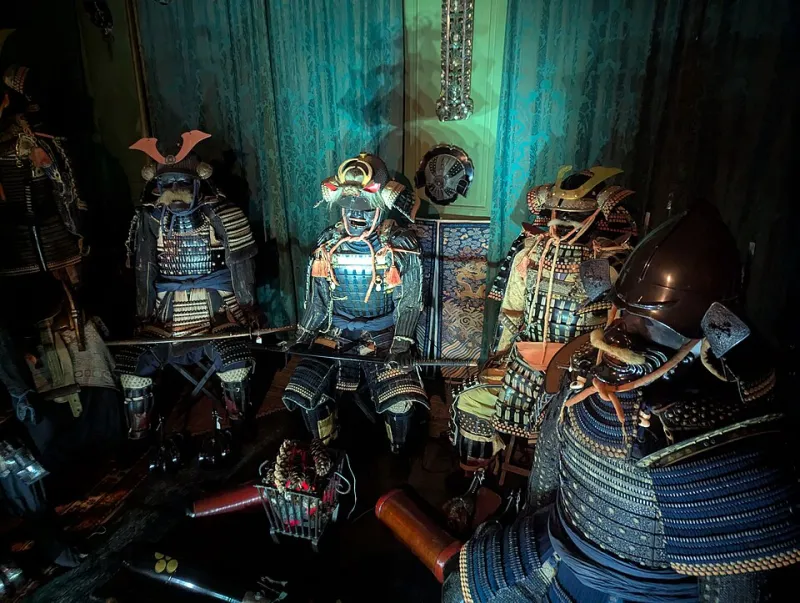
Photo: Tadeusz Hare, CC BY-SA 4.0, via Wikimedia Commons
Centuries before Harvard Business School codified leadership theory, Japanese samurai were living by a rigorous ethical code that addressed loyalty, integrity, and resilience with striking precision. Today, a growing number of American executives and organizational psychologists are turning to Bushido not as a novelty, but as a serious framework for navigating the pressures of modern corporate life. The parallels are more than superficial—they are structural.
Bushido, often translated as "the way of the warrior," emerged as a formalized philosophy during Japan's feudal period, crystallizing the moral obligations of the samurai class. Its seven core virtues—gi (righteousness), yū (courage), jin (compassion), rei (respect), makoto (honesty), meiyo (honor), and chūgi (loyalty)—were not abstract ideals. They were operational principles, tested daily in conditions of extreme consequence. That context, it turns out, translates with remarkable fidelity to the high-stakes environment of Fortune 500 leadership.
Righteousness and the Ethics of Decision-Making
Among Bushido's virtues, gi—the commitment to moral rectitude—may be the most immediately applicable to corporate governance. In the samurai tradition, righteousness was not situational. A warrior did not recalibrate his ethics based on political convenience or personal gain. He acted correctly because correctness was its own justification.
For American business leaders navigating an era of intensified regulatory scrutiny and public accountability, this posture carries practical weight. Organizational psychologists who study ethical decision-making note that companies with clearly articulated moral frameworks—ones that permeate culture rather than exist only in compliance manuals—demonstrate measurably stronger employee retention and stakeholder trust. The samurai's insistence on principled action regardless of external pressure mirrors what contemporary researchers call "values-based leadership," a model increasingly linked to long-term organizational health.
The collapse of once-dominant corporations due to ethical failures is a recurring feature of modern American business history. Bushido would have diagnosed those failures early: a warrior who compromises gi once has already lost his way.
Courage, Compassion, and the Dual Mandate of Leadership
One of the most instructive tensions within Bushido is the relationship between yū (courage) and jin (compassion). Western leadership culture has often treated toughness and empathy as opposing forces—a false binary that has produced generations of leaders who mistake severity for strength. The samurai tradition rejected this dichotomy entirely.
A samurai was expected to act with decisive courage under pressure while simultaneously cultivating genuine concern for those under his protection. This duality is not merely philosophical; it is neurologically sound. Research in organizational behavior consistently demonstrates that leaders who combine high accountability with authentic empathy generate stronger team cohesion, higher productivity, and lower burnout rates—outcomes that matter enormously in today's competitive American labor market, where employee disengagement costs the economy an estimated $550 billion annually.
Leaders who embody both yū and jin create what might be called psychologically safe accountability—an environment where people are held to rigorous standards and simultaneously feel genuinely supported. This is not a soft management strategy. It is, in the samurai sense, a complete one.
Respect, Ritual, and the Architecture of Corporate Culture
The virtue of rei—respect, expressed through deliberate courtesy and formal conduct—might seem at odds with the casual, first-name-basis culture that defines many American workplaces. But its deeper application is not about formality for its own sake. It is about the recognition that how people treat one another within an organization shapes the organization's character.
Samurai observed elaborate protocols of address and conduct not to impose hierarchy arbitrarily, but to signal that every interaction carried moral weight. In corporate terms, this translates to the intentional design of workplace culture: how meetings are conducted, how feedback is delivered, how disagreement is managed. Organizations that treat these moments as consequential—rather than incidental—build cultures of mutual accountability that prove resilient under stress.
The ritual dimensions of samurai life, often dismissed as ceremonial excess, were in fact technologies of discipline. They made virtue habitual. American companies that invest in consistent cultural rituals—structured recognition, transparent communication cadences, deliberate onboarding—are, whether they know it or not, applying a principle the samurai understood deeply.
Honesty and Honor in an Age of Transparency
Makoto and meiyo—honesty and honor—are perhaps the virtues most urgently needed in the current American business climate. The rise of social media, whistleblower protections, and real-time corporate scrutiny has made transparency not merely a virtue but a competitive necessity. Leaders who dissemble, who manage perception rather than reality, face an environment that is increasingly unforgiving.
The samurai concept of honor was intimately bound to public accountability. A warrior's reputation was his most durable asset—more valuable than wealth, more enduring than rank. Modern executives operate in an analogous environment. Brand equity, which analysts increasingly link to leadership integrity, can be built over decades and destroyed in days. The samurai would have recognized this dynamic immediately.
Honesty, in the Bushido framework, was not simply the absence of lying. It was the active cultivation of transparency as a form of respect—for one's subordinates, one's rivals, and one's own character. Leaders who internalize this distinction operate differently. They communicate difficult truths proactively. They acknowledge failure without evasion. They build organizations that can tolerate honest feedback, which is ultimately the only kind that improves performance.
Loyalty Reimagined: Beyond Tenure and Toward Shared Purpose
Perhaps no Bushido virtue requires more careful translation than chūgi—loyalty. In the feudal Japanese context, loyalty was hierarchical and absolute, binding the samurai to his lord with obligations that superseded personal interest. Direct application of this model to modern American corporate life would be neither appropriate nor desirable.
But the underlying principle—that sustained commitment to a shared purpose creates the conditions for extraordinary collective achievement—remains entirely valid. The challenge for contemporary leaders is to earn loyalty rather than assume it, and to direct it toward mission rather than toward individual personalities.
Organizations that articulate a compelling purpose, align their practices with their stated values, and treat their people with consistent dignity find that loyalty follows naturally. The samurai did not pledge himself to an abstraction; he pledged himself to a lord who had demonstrated worthiness. Modern employees operate by a similar logic, even if they would not describe it in those terms.
The Warrior's Path as a Leadership Practice
Bushido was never merely a code to be memorized. It was a practice—a daily discipline of self-examination, self-correction, and deliberate action. The samurai who embodied its virtues did so not because he had achieved perfection, but because he had committed to the ongoing work of character development.
This orientation—the understanding that leadership is not a destination but a continuous practice—may be the most valuable contribution Bushido offers to the American executive. In a business culture that celebrates arrival, the samurai tradition insists on the primacy of the path. The seven virtues are not a checklist. They are a compass.
For leaders willing to engage with them seriously, they point toward something the most sophisticated management theory has always sought and rarely captured: the integration of moral depth and practical effectiveness in a single, coherent way of being.