When the Katana Met the Arquebus: The Real Story Behind the Samurai's Complicated Relationship With Gunpowder
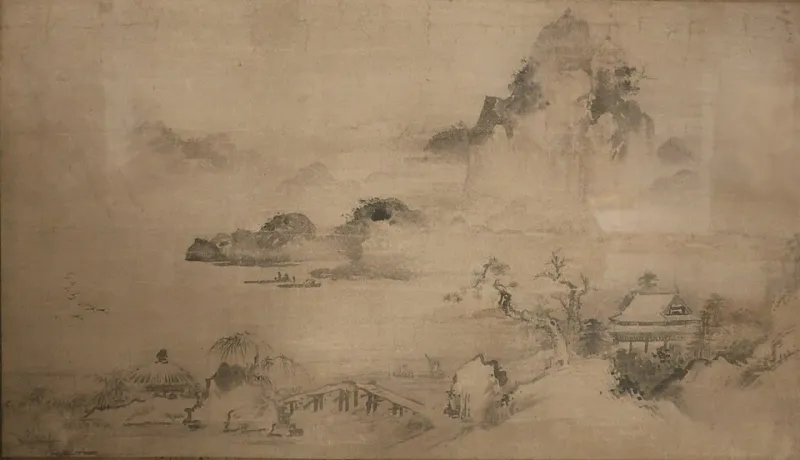
Photo: UnknownUnknown, Public domain, via Wikimedia Commons
Few narratives in Japanese history have been as persistently romanticized — and as persistently misrepresented — as the story of the samurai and the gun. Western popular culture, from Hollywood films to mainstream history podcasts, tends to frame the encounter as a morality play: the ancient, spiritually superior sword confronting the crude, democratizing firearm, with tradition ultimately yielding to modernity. It is a satisfying story. It is also, in significant measure, a distortion.
The actual history of how Japanese warrior culture absorbed, deployed, resisted, and ultimately reconciled itself with Portuguese firearms is far messier, far more economically motivated, and far more instructive than the simplified version allows. And for a contemporary American audience watching industries grapple with artificial intelligence, automation, and digital disruption, the 16th-century Japanese experience carries some genuinely unexpected resonances.
The Arrival of the Tanegashima
In 1543, a Portuguese trading vessel made landfall on the small Japanese island of Tanegashima, carrying among its cargo a new kind of weapon: the matchlock arquebus, known in Japan as the tanegashima after the island where it first appeared. The local lord, Tanegashima Tokitaka, reportedly purchased two of the firearms and immediately set his swordsmiths to work reverse-engineering them.
This detail alone should disrupt the romantic narrative. The initial Japanese response to firearms was not rejection — it was rapid, pragmatic adoption. Within a decade, Japanese craftsmen had not only replicated the arquebus but had improved upon several of its mechanical features. By the 1560s, Japan was producing firearms in quantities that would have surprised the Portuguese merchants who first introduced them.
The warlord Oda Nobunaga understood the tactical implications earlier and more decisively than virtually any of his contemporaries. At the Battle of Nagashino in 1575, Nobunaga deployed an estimated 3,000 arquebusiers in rotating volley formations against Takeda Katsuyori's cavalry — a tactical innovation that obliterated the Takeda forces and demonstrated, with brutal clarity, that the age of the mounted samurai charge was effectively over.
The Economics Beneath the Ideology
If the samurai class was capable of such rapid and sophisticated adoption of firearms technology, why does the narrative of resistance persist so strongly? The answer lies partly in ideology and substantially in economics — and the two were never entirely separable.
The samurai occupied a hereditary social position defined in part by their exclusive mastery of certain weapons and martial disciplines. The sword, and to a lesser extent the bow and the spear, were not merely tools of war. They were markers of social identity, legal privilege, and cultural authority. A weapon that could be operated effectively by a peasant foot soldier with minimal training represented a direct challenge to the social architecture that justified samurai privilege.
This economic and social anxiety was real, and it shaped policy in ways that outlasted the Sengoku period. Toyotomi Hideyoshi's famous "sword hunt" of 1588, which confiscated weapons from non-samurai classes, was motivated at least as much by the desire to reassert class boundaries as by any practical concern about peasant uprisings. Firearms were conspicuously absent from the confiscation orders — a fact that complicates any straightforward reading of the policy as anti-technology traditionalism.
During the Edo period, under Tokugawa rule, firearms production was deliberately curtailed and centralized under government control. This is the moment most frequently cited as evidence of samurai resistance to guns — but it is more accurately understood as an act of political consolidation by a regime that had already won its wars and now needed to manage internal stability rather than external conquest. Guns were not rejected because they were spiritually inferior to swords. They were restricted because a heavily armed population, regardless of weapon type, was inconvenient for an authoritarian peace.
The Katana as Cultural Technology
None of this is to suggest that the sword held no genuine cultural significance beyond its utility as a status symbol. The katana's place in samurai philosophy was real and deeply embedded. The sword was understood as an extension of the warrior's spirit — tamashii — and the forging process itself was a ritualized act with spiritual dimensions that no arquebus could replicate.
But it is worth distinguishing between the sword's philosophical meaning and the claim that samurai rejected firearms on philosophical grounds. The historical record does not strongly support the latter. What it does support is a picture of a warrior class that adopted new technology selectively, managed its implications strategically, and used cultural narratives about tradition partly as instruments of political and economic self-interest — a dynamic that will feel recognizable to anyone who has observed how established industries respond to disruptive innovation.
A Mirror for Technological Disruption Today
The parallels to contemporary debates in the United States are difficult to ignore. Across industries — from journalism to manufacturing to legal services — established professional classes are confronting technologies that threaten to redistribute expertise and erode the barriers to entry that have historically defined their status and income. The rhetorical strategies deployed in these debates frequently invoke quality, tradition, and the irreplaceable value of human judgment in ways that echo, however distantly, the cultural arguments samurai-era Japan constructed around the sword.
This is not an argument that resistance to technological change is always cynical or self-serving. Genuine concerns about quality, safety, and the social costs of rapid disruption deserve serious engagement. But the Japanese experience suggests that warrior cultures — and professional cultures more broadly — are often more adaptive than their public rhetoric implies, and that the gap between stated values and actual behavior tends to widen considerably when economic survival is at stake.
The samurai did not choose the sword over the gun because they were too proud to adapt. They navigated a complex negotiation between utility, identity, social order, and political power — and the weapons they ultimately kept closest were the ones that served all of those interests simultaneously.
That is a lesson in technological disruption that no business school case study has quite managed to capture.