The Myth of Absolute Loyalty: How Samurai Betrayal Exposes the Hidden Politics of Honor Codes
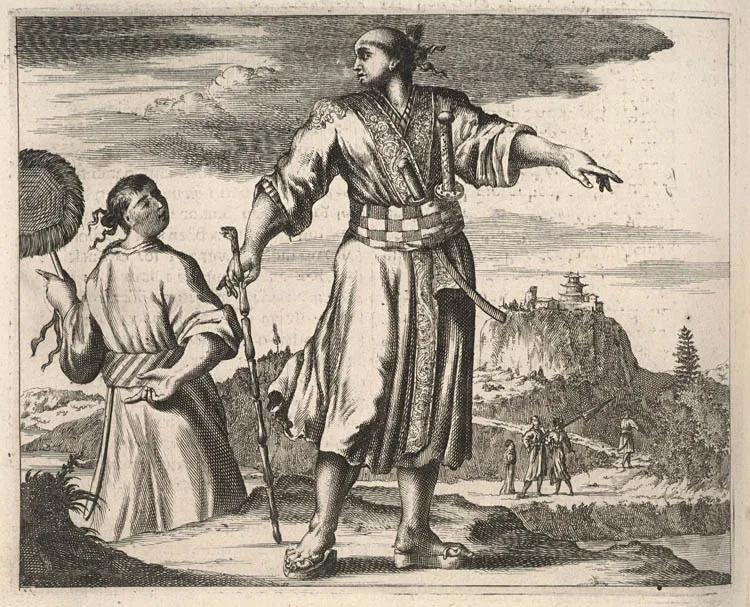
Photo: Unknown, Public domain, via Wikimedia Commons
Few concepts in Japanese warrior culture carry the romantic weight of chuu—loyalty—the principle that bound samurai to their lords with an obligation portrayed as absolute, eternal, and morally non-negotiable. In the popular imagination, shaped by centuries of kabuki theater, woodblock prints, and more recently Hollywood films, the samurai stands as the archetype of unwavering fidelity: a warrior who would sooner accept death than dishonor his master through disloyalty. It is a compelling image. It is also, the historical record makes abundantly clear, a significant distortion of how feudal Japanese warriors actually behaved.
The distance between Bushido's loyalty doctrine and the political reality of samurai Japan is not a minor footnote. It is, in fact, one of the most instructive features of the entire tradition—and understanding it tells us something important not only about feudal Japan but about the nature of honor codes wherever and whenever they appear.
What Bushido Actually Demanded—and When It Was Written
Before examining the violations, it is worth interrogating the code itself. The texts most commonly cited as expressions of Bushido—Yamamoto Tsunetomo's Hagakure, written around 1716, and Inazo Nitobe's Bushido: The Soul of Japan, published in 1900 specifically for a Western audience—were composed not during the height of samurai political power but largely after it had passed. The Hagakure was written during the Edo period, when decades of enforced peace had rendered samurai a largely administrative class with diminishing martial relevance. Nitobe's work was a Meiji-era nationalist construction aimed in part at presenting Japan as a civilization with noble values comparable to European chivalric traditions.
This timing matters enormously. The most absolutist articulations of samurai loyalty were codified precisely when the conditions that had made loyalty strategically flexible—active warfare, competing warlords, fluid political allegiances—no longer existed. The code, in its most rigid form, was written for a world that had already disappeared. What filled the vacuum of actual martial purpose was ideology: a retrospective idealization that served the Tokugawa state's interest in maintaining social order and the Meiji government's interest in forging a unified national identity.
The Betrayals the Textbooks Prefer to Footnote
The Sengoku period—the century of near-continuous civil war stretching roughly from the mid-fifteenth to the early seventeenth century—provides the richest evidence of how samurai actually navigated loyalty when survival and advancement were at stake. The era's defining characteristic was not steadfast fidelity but rather a sophisticated, often ruthless pragmatism in which allegiances shifted with the military and political winds.
Akechi Mitsuhide's assassination of Oda Nobunaga in 1582 stands as perhaps the most dramatic single instance of a retainer turning against his lord. Mitsuhide was not a minor figure acting from personal grievance alone—he was one of Nobunaga's most capable generals, and his betrayal at Honnō-ji shattered the most powerful military coalition in Japan at the time. Whatever his precise motivations, the act was unambiguous: a senior samurai destroyed the man to whom he owed absolute loyalty, by the very standards Bushido would later prescribe.
Mitsuhide's case is exceptional in its scale but not in its kind. Throughout the Sengoku period, defection was sufficiently common that warlords developed elaborate systems of hostage-taking specifically to constrain the loyalty calculations of their retainers. If loyalty were genuinely the iron moral imperative that later texts proclaimed, such mechanisms would have been unnecessary. Their very existence acknowledges that samurai were rational political actors weighing costs and benefits—not saints compelled by unshakeable virtue.
Tokugawa Ieyasu himself, the man who ultimately unified Japan and whose family would rule for over two and a half centuries, built his career on a sequence of strategic realignments. His early years involved serving the Imagawa clan under circumstances that amounted to enforced vassalage; his subsequent alliances with Nobunaga, his maneuvering after Nobunaga's death, and his eventual elimination of rivals at Sekigahara in 1600 reflect a political intelligence that operated well outside the boundaries of simple loyalty. Ieyasu was not unusual among the period's great figures. He was simply more successful.
Honor as Instrument: The Control Function of Loyalty Doctrine
The gap between proclamation and practice invites a harder question: if samurai routinely violated loyalty norms when circumstances warranted, why did the doctrine of absolute loyalty become so central to warrior culture's self-presentation?
The answer lies in understanding whose interests the doctrine served. Loyalty codes, in feudal Japan as in many hierarchical societies, functioned primarily as tools of downward control. A lord who could convince his retainers that betrayal was not merely strategically risky but morally catastrophic—a stain on one's soul, one's family, and one's descendants—possessed a far more reliable workforce than one who depended on material incentives alone. The ideology transformed what was essentially an employment relationship into a sacred bond, and in doing so shifted the moral burden of any rupture entirely onto the subordinate.
This asymmetry is crucial. The historical record contains abundant examples of lords who treated retainers capriciously, withheld promised rewards, and violated their own obligations without suffering comparable ideological condemnation. The Hagakure itself, for all its rhetoric of selfless service, occasionally acknowledges that lords could be foolish, cruel, or incompetent—yet the prescribed response remained service unto death. The doctrine demanded unconditional loyalty from those with less power while offering considerably more flexibility to those with more.
Uncomfortable Parallels for the American Workplace
For a contemporary American audience, the resonance of this dynamic requires little elaboration. Corporate culture in the United States has long drawn on martial and quasi-military metaphors, and the language of loyalty—to the company, to the brand, to the team—remains pervasive in organizational life. Employees are regularly encouraged to demonstrate commitment that mirrors the samurai ideal: total dedication, prioritization of institutional interests over personal ones, and an implicit understanding that questioning the hierarchy represents a form of disloyalty.
The samurai historical record suggests that healthy skepticism toward such demands is not a moral failing but a form of clear-sightedness. The warriors who survived and shaped Japanese history were, by and large, those who understood loyalty as a conditional and reciprocal relationship rather than an absolute obligation flowing in one direction only. They recognized, even if they rarely articulated it openly, that honor codes could be weaponized by the powerful against the less powerful.
None of this diminishes the genuine moral seriousness with which many samurai approached questions of duty, integrity, and obligation. Those values were real, and they produced acts of extraordinary courage and self-sacrifice. But they coexisted, in the historical record, with a political realism that the later idealized portrait of Bushido systematically obscures.
Reading the Code Against Itself
The most honest engagement with samurai warrior culture does not require choosing between reverence and cynicism. It requires the willingness to hold both the ideal and the reality in view simultaneously—to recognize that the Hagakure's vision of total self-surrender in service to one's lord was genuinely inspiring to many who read it, and also that it was written to serve specific political interests, and also that the samurai who populated actual Japanese history were far more complicated human beings than the doctrine allowed.
That complexity is not a failure of the tradition. It is, arguably, its most valuable legacy. The samurai who switched sides at Sekigahara, the retainer who calculated whether his lord deserved his ultimate sacrifice, the warlord who built an empire through strategic flexibility rather than rigid fidelity—these figures remind us that honor is most meaningful when it is chosen rather than compelled, and most dangerous when it is deployed as a mechanism of control dressed in the language of virtue.