The Eloquence of Emptiness: How Samurai Mastered the Art of Saying Nothing
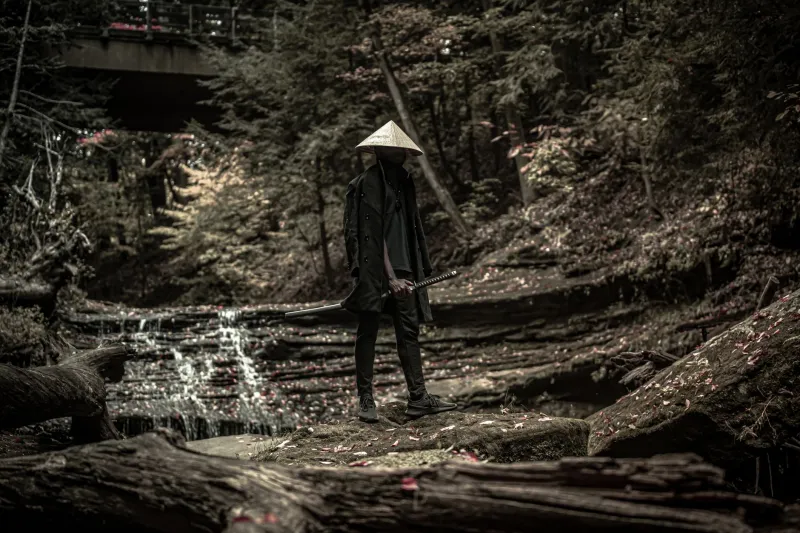
In contemporary American culture, silence tends to make people uncomfortable. We fill it with small talk, notifications, background music, and the endless scroll of social media feeds. Quiet is treated as a void demanding to be occupied. Yet for the samurai of feudal Japan, silence was not an absence — it was a language unto itself, one that demanded fluency, discipline, and considerable courage to speak.
The warrior tradition of Japan cultivated an understanding of communication that extended far beyond the spoken word. Restraint was considered a mark of refinement. A samurai who spoke carefully, sparingly, and with deliberate weight was regarded as more trustworthy — and more dangerous — than one who filled every room with words.
Ma: The Interval That Speaks
At the heart of Japanese aesthetic and philosophical thought lies a concept largely untranslatable into English: ma (間). Roughly rendered as "negative space" or "meaningful interval," ma describes the pregnant pause between sounds, the charged stillness between actions, the gap between question and answer that carries as much meaning as the words themselves.
In the context of samurai communication, ma was not hesitation — it was precision. A lord who received a petition and allowed a long, controlled silence before responding was not stalling. He was signaling deliberation, authority, and an inner composure that no amount of rapid speech could convey. The interval itself communicated: I am not ruled by urgency. I am not moved by your pressure. I will answer when I am ready.
This same principle governed the dojo. Martial instructors of the classical schools rarely explained at length. They demonstrated, then waited. Students were expected to observe, absorb, and internalize — not to pepper their teachers with questions. The silence of a master was itself instruction, compelling the student to develop their own capacity for attentive observation rather than passive reception.
The Gaze That Precedes the Blade
In swordsmanship, nonverbal communication was not merely philosophical — it was tactical. The classical Japanese concept of metsuke (目付), often translated as "gaze" or "eye contact," described the manner in which a skilled swordsman directed his attention during a confrontation. The uninitiated fighter watched the opponent's blade. The trained warrior watched nothing in particular and everything at once, maintaining a soft, unfocused gaze that allowed peripheral awareness to dominate.
This quality of presence communicated something to an opponent before a single movement was made. A swordsman who carried metsuke correctly projected a stillness that was, paradoxically, deeply unsettling to face. There was nothing to read, no telegraphed intention, no emotional signal to exploit. The silence of the body was its own form of intimidation.
Miyamoto Musashi addressed this phenomenon in The Book of Five Rings, cautioning warriors against revealing their interior state through facial expression, posture, or hurried movement. The warrior who controlled his outward silence, Musashi argued, controlled the psychological terrain of the encounter before it began.
Silence in the Court: Negotiation and Political Power
The samurai class was not composed solely of battlefield fighters. Many served as administrators, advisors, and diplomatic envoys — roles that demanded a sophisticated command of social communication. In these settings, verbal restraint functioned as a display of rank and inner strength.
Japanese court culture placed tremendous weight on what was not said. The concept of kuuki wo yomu — "reading the air" — described the social expectation that a perceptive individual would understand the unspoken dimensions of a conversation: the status dynamics beneath polite phrasing, the objection concealed within a compliment, the warning embedded in a seemingly casual remark. A samurai who could read the air and respond with calibrated silence, rather than blundering into explicit confrontation, demonstrated a form of intelligence that was highly prized.
In negotiation, this translated into a recognizable strategy. The party that spoke least often held the most leverage. To respond immediately was to reveal eagerness. To fill silence with reassurances was to betray anxiety. The samurai tradition understood, centuries before modern negotiation theory formalized the principle, that the person most comfortable with silence typically wins the exchange.
Restraint as a Moral Discipline
Beyond tactics, the cultivation of verbal restraint was understood as a moral and spiritual practice. The Confucian and Zen influences that permeated samurai culture both emphasized the dangers of careless speech. Words uttered in haste, anger, or vanity were considered evidence of an undisciplined mind — the very opposite of the composed interior state that warrior training sought to produce.
The Hagakure, the eighteenth-century text compiled from the reflections of the samurai Yamamoto Tsunetomo, is notably sparse in its endorsement of eloquence. Tsunetomo repeatedly returns to the virtue of acting decisively and speaking minimally. "It is bad when one thing becomes two," he observed — a warning against the tendency to over-explain, over-justify, and over-qualify. Clarity of purpose required clarity of expression, and clarity of expression often meant saying less.
This was not anti-intellectualism. The samurai tradition produced poets, scholars, and philosophers of considerable sophistication. Rather, it was a recognition that words carry weight, and that weight should be managed with the same care one brings to the handling of a blade.
Applying the Principle in a Digital Age
For American readers navigating a culture of relentless self-expression — where professional visibility is measured in posts, engagement metrics, and the volume of one's public voice — the samurai's philosophy of deliberate silence offers a genuinely countercultural alternative.
Consider the professional who responds to a difficult email not within minutes, but after considered reflection. Consider the leader who, in a tense meeting, allows silence to settle before offering a measured response rather than rushing to fill the discomfort. Consider the negotiator who makes an offer and then, resisting every social impulse, simply waits.
These are not passive choices. They are active exercises in the kind of self-mastery that the samurai tradition placed at the center of warrior development. The discipline required to hold one's tongue — to resist the impulse to explain, defend, or perform — is no less demanding than the physical conditioning of the dojo.
In an era defined by information overload, the warrior who can be still, who can listen with full attention, and who can choose silence over reflexive noise, possesses a form of power that is both ancient and urgently contemporary.
The Unspoken Invitation
Perhaps the deepest lesson of the samurai's relationship with silence is this: restraint is not withdrawal. The warrior who said little was not absent from the room — quite the opposite. His silence created space for others to reveal themselves, for situations to clarify, and for the right moment of action to announce itself without being forced.
In this sense, silence was never passive. It was the most active form of presence available to the disciplined mind — a listening so complete, an attention so undivided, that words would only have diminished it.
The samurai understood what many modern communicators have forgotten: sometimes, the most powerful thing you can say is nothing at all.